Three paths to the page
How local authors, Bill Oakes, Clint Smith and Randy Pinegar, found their voices
By Amanda Stevenson-Holmes // Photography by Angie Kroger and submitted
Every author has a different origin story. Some spend decades dreaming of writing a novel before finally sitting down at the keyboard. Others build fictional worlds between demanding careers. Still others discover that a deeply personal question simply refuses to leave them alone until it becomes a book.
For Indiana authors Bill Oakes, Clint Smith and Randy Pinegar, the road to publication looks different. Oakes is a retired journalist who fulfilled a lifelong goal. Smith is an experienced literary writer balancing a career in education with a growing body of fiction. Pinegar turned years of observing life’s quiet struggles into a faith-centered novel that has already sparked meaningful conversations with readers.
Their books differ in genre and tone, but each author shares something essential – the belief that stories matter because they help people better understand themselves and the world around them.

Bill Oakes
A journalist finally writes the novel
For Oakes, publishing “Chasing Evil” wasn’t a spontaneous decision. He was realizing a goal that had lingered for decades and ignited during the pandemic.
The Franklin resident spent much of his professional life telling other people’s stories. His career included work in broadcast and print journalism before eventually serving as director of business development at Johnson Memorial Health. Yet despite moving away from daily reporting, he never lost the instinct or desire to write.
“I’ve wanted to try writing a novel for a long time,” says Oakes, who penned the book using his full first name William. Most people, however, know him as Bill.
That transition required more than simply changing formats. Journalism demands precision, objectivity and concise storytelling. Fiction asks for imagination, character development and the patience to build an entire world from scratch.
“It took two years of writing and rewriting to get the book into its final form,” says Oakes, who was inspired by various authors and their advice. “The most consistent advice I received was ‘if you want to write, keep writing’ and that’s the advice I would give others as well.”
That willingness to write and revise became one of the defining parts of his process. Rather than racing toward publication, Oakes embraced rewriting as an essential step. His first novel became an exercise in learning an entirely new craft after years of professional writing in another medium.
His journalism background still shaped his approach. “Chasing Evil” is rooted in familiar Indiana communities including Noblesville — where Oakes grew up, Greenwood, Franklin and Johnson County and follows an Indiana State Police detective investigating murders that remained unsolved for three decades. The authentic settings reflect someone who knows these communities well, while the investigative structure draws naturally from years spent gathering facts and asking questions as a reporter.
Although “Chasing Evil” marks Oakes’ debut as a novelist, the book showcases an experienced communicator applying decades of storytelling experience to a different canvas.
Clint Smith
Clint Smith
Building fiction between school years
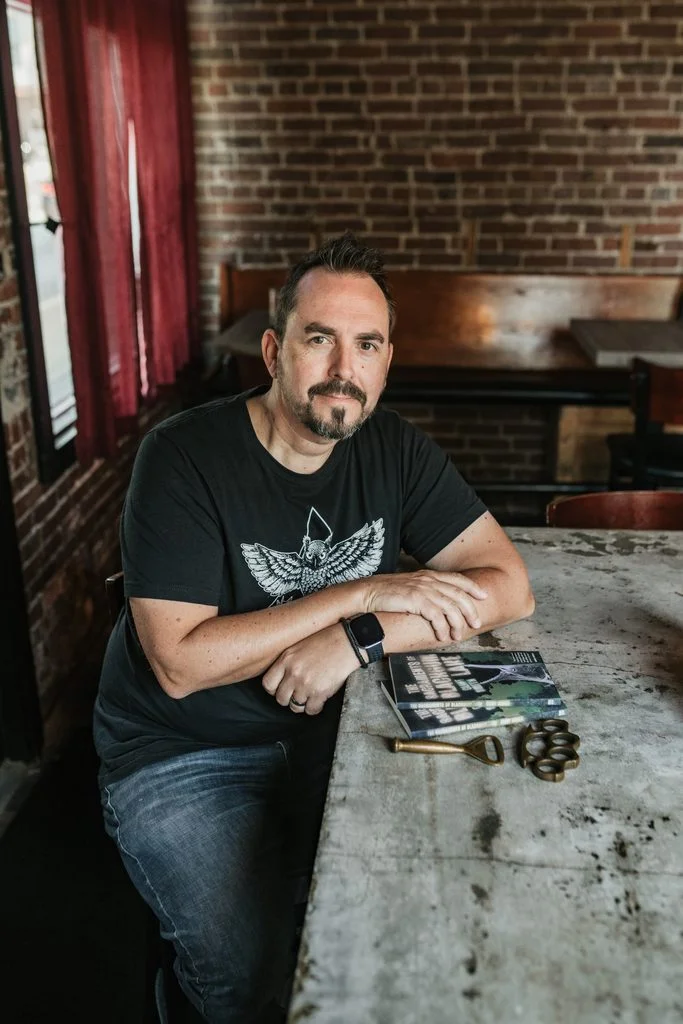
While Bill Oakes came to fiction after retirement, Clint Smith has spent years quietly building a literary career while teaching full time. For more than two decades, he’s balanced lesson plans, students and kitchens with the demands of fiction writing, while serving as a chef-instructor in the Culinary Arts department at Central Nine Career Center in Greenwood.
His latest release, “The Sacraments of Blackgum Lake,” continues an established body of work rather than introducing readers to a new voice. Unlike authors who separate their lives into career and creative pursuits, Smith has spent years living both simultaneously.
“Obviously, a significant portion of time is preoccupied with one’s employment persona, so the time we create operates as an artistic antidote to our everyday routines,” explains Smith. “I’ve found that it’s that tension between the two that sustains the writing process. Essentially, that sort of friction fosters fiction.”
His stories often draw inspiration from southern Indiana — not by recreating locations exactly, but by blending memories into fictional landscapes. Communities such as Wanamaker and Acton become transformed into fictional places like Deacon’s Creek, Sycamore Mill and Crooke’s Chapel. That blending of reality and imagination allows Smith to preserve emotional truth without becoming constrained by geography.
His newest novella centers on a father and son renovating a lakeside cabin while confronting legends surrounding the fictional Blackgum Lake, a location inspired in part by Owen County’s Lake Hollybrook and long-standing folklore connected to notorious bank robber John Dillinger. Rather than chasing sensationalism, Smith appears fascinated by how local legends become woven into ordinary lives.
His writing demonstrates the patience of someone who understands atmosphere often matters more than action. Teaching likely contributes to that perspective. Working with students for more than two decades means constantly observing people, relationships and personal growth. The same raw material that fuels compelling fiction.
Smith’s continuing publications suggest writing isn’t simply a hobby squeezed into spare evenings. It has become an enduring creative practice that evolves alongside his teaching career.
Randy Pinegar
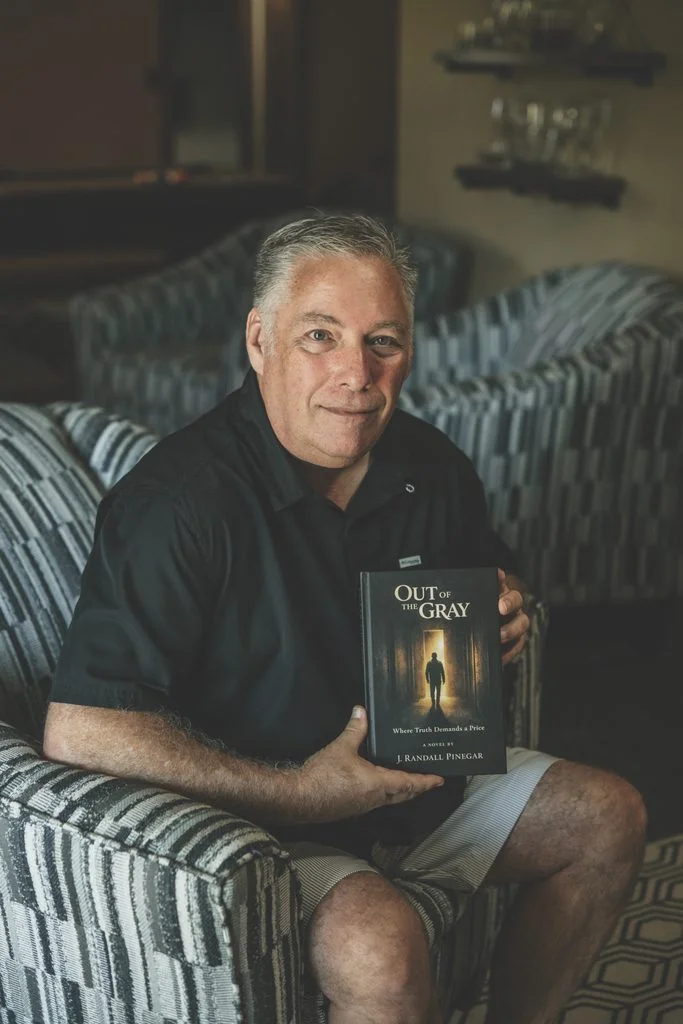
Exploring the quiet drift If Oakes writes from journalistic curiosity and Smith from literary imagination, Randy Pinegar writes from observation. His debut novel, “Out of the Gray,” began with a question that lingered for years.
“Most men don’t fall apart dramatically — they drift quietly,” Pinegar says.
That single observation became the foundation for an entire novel. Rather than focusing on spectacular failures, Pinegar became interested in the subtle compromises that gradually reshape people’s lives. He describes the central character, Joe Harrison, not as a reflection of himself but as a composite of many men.
“Joe isn’t me, but he carries pieces of me, and pieces of men I’ve known,” shares Pinegar.
Those years of observation gave Pinegar plenty of material before he ever began writing. The process itself stretched over several years, growing even more personal after the death of his father in March 2025. While fatherhood and legacy were not originally central themes, Pinegar says they naturally emerged as he reflected on the lessons his own father left behind.
“‘Out of the Gray’ delivers a spiritual arc, but there are other offerings too, that will keep a reader’s attention,” teases Pinegar. “A suspenseful plot built on secrets, hidden motives, and moral tension. The story will remind readers that even in the complicated pieces of our lives, truth is constant and powerful. Stepping toward truth can change everything.”
And stepping forward, Pinegar already knows where the story is headed. A sequel, Into the Light, is already planned, continuing the journey begun in “Out of the Gray.”
Different Journeys, Shared Purpose Although these three Indiana authors arrived at publication through very different routes, similarities emerge. Each author demonstrates that writing is rarely a quick endeavor. Oakes spent two years revising his first novel before publication. Pinegar developed his story across several years as life itself reshaped its themes. Smith’s work reflects decades of steadily refining his craft while maintaining a demanding teaching career.
Their experiences challenge the romantic notion that books simply appear through flashes of inspiration. Instead, writing emerges as disciplined, persistent work requiring revision, patience and the willingness to continue even when publication remains uncertain.
Perhaps that’s what connects all three authors most strongly. Each reached publication from a different starting point, a retired journalist, a veteran educator and an observer of life’s quiet struggles, but none arrived by accident. They wrote because they felt compelled to tell stories that had been growing within them.
And none considers this the end of the journey. Oakes has plotted three more books in the Chasing Evil series. Smith continues adding to an already established literary career, and Pinegar is already preparing readers for the next chapter with Into the Light.